AI
FICS Attest · AI Validation
The AI-native CSA validation platform that replaces spreadsheets and manual testing, for good.
Built for the CSA era
Inside the product
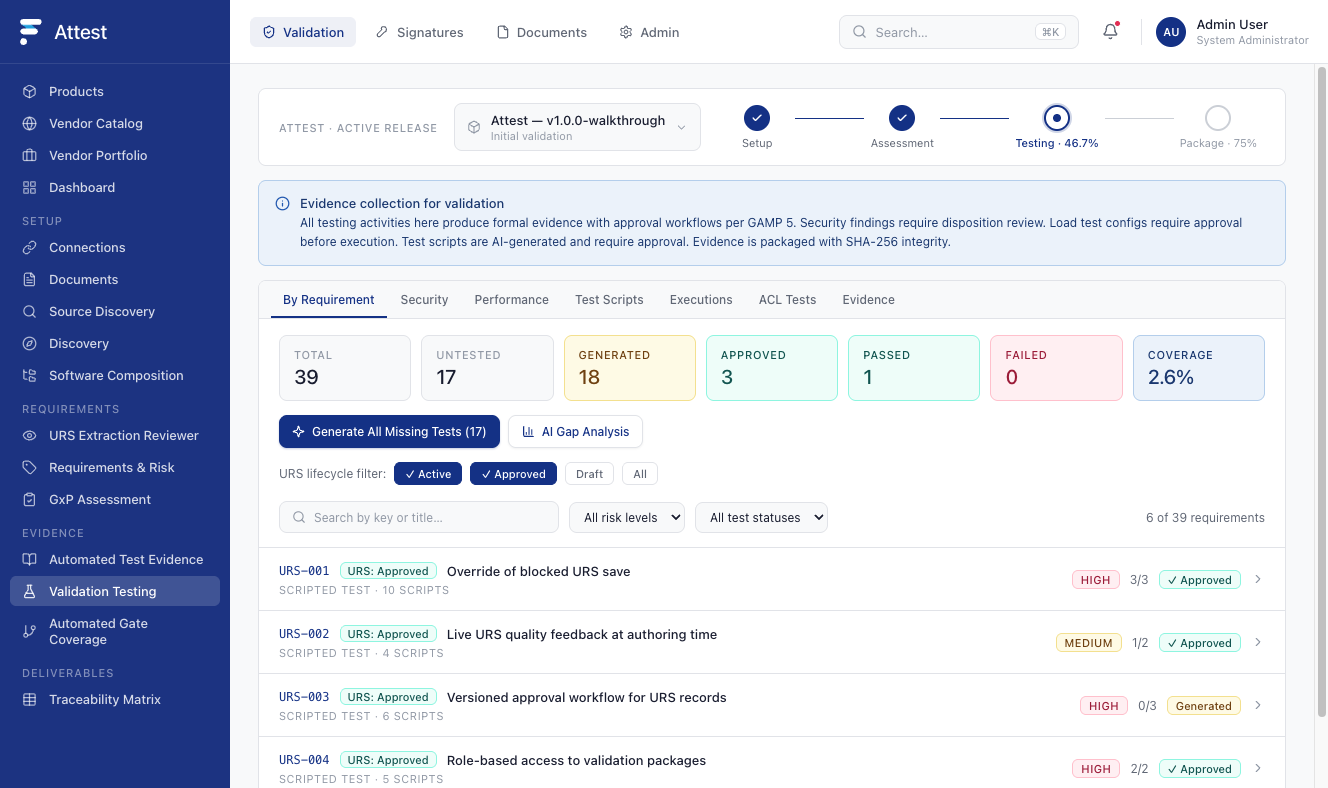
Validation that assembles its own evidence
The Problem
Validation is the bottleneck slowing every release
Slow Releases
Validation cycles take 4–6 weeks per release, creating a bottleneck that delays software improvements and trial timelines.
Fragile Manual Processes
CSV-era spreadsheets and manual test cases require hundreds of hours of FTE labor, with high error rates and poor traceability.
Audit Risk
Fragmented documentation across tools and teams means inspection-readiness is never guaranteed, and gaps can surface at the worst moments.
FDA's CSA guidance demands a risk-based, automation-first approach, but most platforms haven't caught up.
CSV vs CSA
A different approach to assurance
Old World: CSV
- Test everything, document everything
- Compliance proven through sheer volume
- High effort, low signal
- Months-long validation cycles
- Static documentation, instant obsolescence
New World: CSA
- Test what matters, risk-based scoping
- Justify decisions with critical thinking
- High confidence, right effort
- Days-long validation cycles
- Continuous, living documentation
FICS Attest is built from the ground up for CSA, not retrofitted from a CSV-era product. FDA Computer Software Assurance (Final Guidance, September 2025) is the most significant regulatory shift in validation in two decades.
What It Does
What CI/CD did for software deployment, FICS Attest does for GxP validation
Risk-Based Test Scoping
Auto-determines what to test based on GAMP category, system criticality, and change impact, eliminating redundant testing.
CSA-Aligned Documentation
Generates audit-ready validation packages formatted to FDA CSA and GxP expectations, no legacy templates required.
Continuous Validation
Direct interface with applications so validation runs alongside development, not as a downstream bottleneck after release.
Audit Trail & Traceability
Every decision, test, and deviation is auto-traced and auditable. Inspection-ready at any point in the release cycle.
How It Works
From release scope to a submittable validation package
- 1
Define Release Scope
Work items sync directly from your ticketing system.
- 2
AI Agent Learns the Application
The agent studies the target application it will validate against.
- 3
GxP Impact Assessment
AI auto-suggests Yes / No / Indirect for each change.
- 4
Risk Assessment
AI draft with historical pattern matching across prior releases.
- 5
Validation Approach
Risk-based testing paired with AI-generated test scripts.
- 6
Auto Traceability
Requirements linked to tests, automatically (Req ↔ Test).
- 7
Evidence Repository
All evidence linked to the release and its requirements.
- 8
Validation Package
Deliverables auto-assembled into a complete, submittable package.
AI Engine, human-in-the-loop
- GxP Impact Suggestion
- FMEA Risk Draft
- Test Script Generation (CSA-aligned: focused, not exhaustive)
- One-Click Assessment Draft
Plugs In, No Rip-and-Replace
The Validation Brain that plugs into your existing stack
Pulls from
Ticketing
User stories, change tickets, and release scope.
Source Control & CI/CD
Commits, diffs, and build & deploy triggers.
Knowledge & Live Systems
SharePoint, Confluence, and live application behavior.
Exports to
Document Repositories
SharePoint and Veeva Vault.
Other Validation Tools
Legacy VLMS and QMS platforms.
Audit Archives
Inspection-ready evidence packages.
FICS Attest is the Validation Brain that plugs into your existing stack. Supports GAMP Cat. 3, 4 & 5.
Measurable ROI
Real savings, at the scale you already run
Example: a mid-size biotech with 10 validated clinical systems and 3 releases per system per year.
90%
Reduction in validation cycle time (weeks → days)
80%
Reduction in FTE hours per release (150 → 30 hrs)
$1.08M
Annual savings on validation FTEs
$4M+
Estimated total annual value (incl. trial acceleration)
| Metric | Before | With FICS Attest |
|---|---|---|
| Avg validation cycle | 4–6 weeks | 3–5 days (~36 days saved) |
| FTE hours per release | 150 hrs | 30 hrs |
| Annual validation FTE cost | $1.35M | $270K |
| Audit readiness | Fragmented | Continuous |
Why Now
The moment for CSA-native validation is here
Built by Clinical Researchers
Created by the team behind FICS, used in production trials.
CSA From Day One
Every design decision reflects FDA's CSA final guidance, no CSV legacy.
Strategic IP With Standalone Value
Extensible beyond FICS, for CROs, sponsors, and tech vendors.
Security & Compliance by Design
Full audit trail, role-based access, 21 CFR Part 11-aligned e-signatures, SOC 2-ready.
Ready to leave CSV-era validation behind?
FICS Attest compresses validation cycles from weeks to days, with auditor-ready outputs at every release.